Aprendizaje en videojuegos
Module Artificial Intelligence
Genre AI
Development date 2020-2021 Academic Year. First semester.
Description
In this project, we work with learning concepts seen in theory, specifically reinforcement learning. Use of Q-Table.
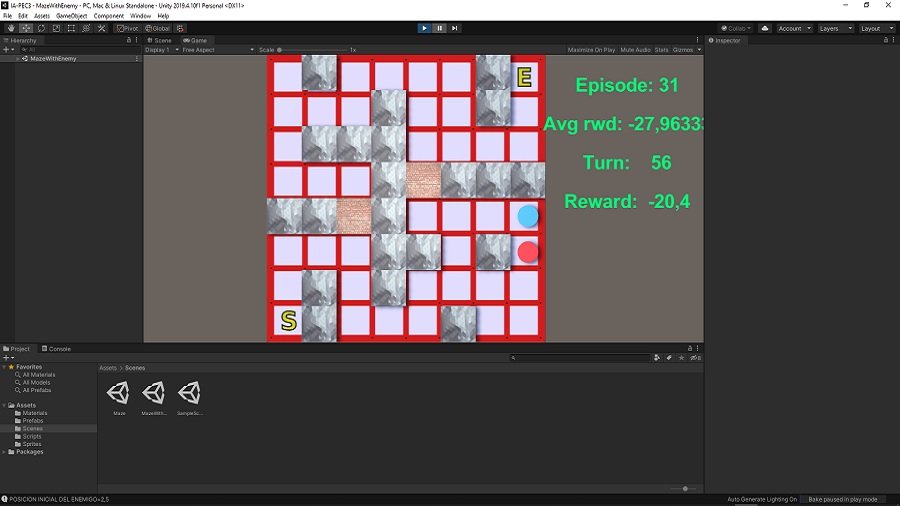
The game involves getting the player (blue cylinder), starting from cell S, to the maze exit, cell E. The player can:
⦁ Move in the 4 cardinal directions (no diagonal movement)
⦁ Walk on free cells
⦁ Destroy brick cells, which then become free cells
⦁ Stone cells cannot be destroyed or walked upon The agent can only perform four actions: move left, right, up, or down. It cannot stay still.
Actions and rewards:
⦁ Move to a free cell: -0.05
⦁ Move to a brick cell (destroying it): -0.2
⦁ Attempt to move to a stone cell (movement blocked, collision): -0.7
⦁ Attempt to move out of bounds (blocked): -0.8
⦁ Reach the exit: +10
Activity 4: An enemy is introduced that can kill the agent.
Activity 5: Enemy is removed and the most beneficial option for the agent in each cell is visualized according to the Q-Table.